
Key Takeaways
- SEO and Meta Robots Tag – Complete 2025 GuideThe Meta Robots tag is one of the most powerful yet misunderstood elements in technical SEO.
- It tells search engines what they can and cannot do with a webpage:Whether to index the page in search results.
- Whether to follow the links on the page.
- How to handle snippets, images, caching, and previews.
- If used correctly, it improves crawl budget efficiency, prevents duplicate content, and protects sensitive pages.
- If misused, it can block your site from Google entirely.
SEO and Meta Robots Tag – Complete 2025 Guide
The Meta Robots tag is one of the most powerful yet misunderstood elements in technical SEO. It tells search engines what they can and cannot do with a webpage:
- Whether to index the page in search results.
- Whether to follow the links on the page.
- How to handle snippets, images, caching, and previews.
If used correctly, it improves crawl budget efficiency, prevents duplicate content, and protects sensitive pages. If misused, it can block your site from Google entirely.
This mastercourse explains everything you need to know about Meta Robots tags, with examples, best practices, and free SEO tools to help you implement them.
Course Modules
- Introduction: What Is the Meta Robots Tag in SEO?
- Why Meta Robots Tag Matters for Google Indexing & Ranking
- Difference Between Meta Robots Tag and Robots.txt File
- Complete List of Meta Robots Directives (Index, Noindex, Follow, Nofollow, etc.)
- How to Add Meta Robots Tag in HTML (Step-by-Step Examples)
- Meta Robots Noindex Tag – When and How to Use It
- Meta Robots Nofollow Tag – What It Means for Link Equity
- Advanced Meta Robots Directives (Noarchive, Nosnippet, Max-Snippet, etc.)
- Meta Robots Tag for Images, Videos, and Multimedia Content
- Best Practices for Using Meta Robots Tags in SEO
- Common Mistakes When Using Meta Robots Tags (And How to Fix Them)
- Meta Robots Tag vs X-Robots-Tag HTTP Header – Key Differences
- Meta Robots and Canonical Tags – How to Use Them Together
- Case Studies: Websites That Benefited from Proper Meta Robots Usage
- Case Studies: SEO Disasters Caused by Wrong Meta Robots Settings
- Tools to Test and Validate Meta Robots Tags (Internal Links)
- Advanced SEO Strategies with Meta Robots Tags in 2025
- Step-by-Step Checklist: Optimizing Meta Robots Tags for Your Website
seo meta robots tag, robots meta tag guide, noindex tag seo, nofollow robots meta, meta robots advanced seo, google indexing robots tag, robots meta directives, seo crawling and indexing
Introduction: What Is the Meta Robots Tag in SEO?
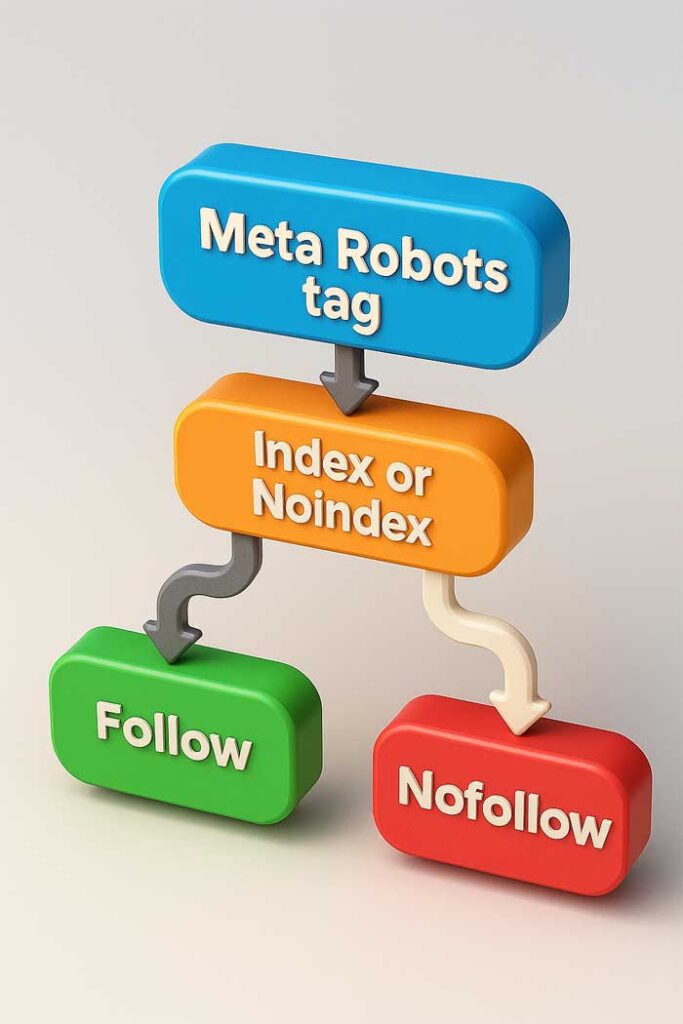
The Meta Robots tag is an HTML element that tells search engines how to crawl and index a webpage. It sits in the <head> section of your HTML and can control:
- Indexing (whether a page should appear in Google).
- Following (whether links on the page should pass authority).
- Snippets (whether Google should show content snippets in SERPs).
👉 Example:
<meta name="robots" content="noindex, nofollow">
👉 Use SEO Audit Tool to check if your site uses Meta Robots tags correctly.
Why Meta Robots Tag Matters for Google Indexing & Ranking
- Helps avoid duplicate content penalties.
- Saves crawl budget by blocking irrelevant pages.
- Controls how content is displayed in search results.
- Protects sensitive pages (login, checkout, thank-you pages).
Meta Robots Tag vs Robots.txt File
- Robots.txt = Controls crawling, not indexing.
- Meta Robots Tag = Controls indexing & snippet display.
👉 Learn more with our guide on Robots.txt SEO.
Complete List of Meta Robots Directives
index→ Allow indexingnoindex→ Prevent indexingfollow→ Allow link equity flownofollow→ Prevent link equity flownoarchive→ Prevent cached versionnosnippet→ Prevent text snippet in SERPmax-snippet→ Limit snippet lengthmax-image-preview→ Control image previewsmax-video-preview→ Control video previews
How to Add Meta Robots Tag in HTML
Example 1 – Noindex a Page:
<meta name="robots" content="noindex">
Example 2 – Allow Index, Block Links:
<meta name="robots" content="index, nofollow">
👉 Validate your tags with Meta Tag Analyzer Tool.
Meta Robots Noindex Tag – When and How to Use It
Use noindex for:
- Duplicate pages (print-friendly versions)
- Thank-you pages
- Admin/login areas
- Test environments
Meta Robots Nofollow Tag – What It Means for Link Equity
- Tells Google not to pass PageRank to linked pages.
- Useful for user-generated content (forums, comments).
- Avoid sitewide nofollow mistakes!
Advanced Directives
noarchive→ Hides cached copy.nosnippet→ Removes text snippets from SERPs.max-snippet:50→ Limits snippet length.max-image-preview:large→ Allows large image previews.
Meta Robots for Images & Videos
- Control whether image previews show in Google Images.
- Control video snippets in search results.
- Useful for copyright-sensitive media.
Best Practices
✅ Default to index, follow unless necessary.
✅ Use noindex for private/duplicate pages.
✅ Combine with canonical tags when needed.
✅ Always test changes in Google Search Console.
Common Mistakes
❌ Sitewide noindex by accident (causes de-indexing).
❌ Using both noindex and canonical incorrectly.
❌ Blocking via robots.txt and expecting noindex to work.
Meta Robots Tag vs X-Robots-Tag HTTP Header
- Meta Robots Tag → Inside HTML.
- X-Robots-Tag → HTTP header (useful for PDFs, images, non-HTML files).
Meta Robots & Canonical Tags Together
- Canonical = Preferred version of a page.
- Meta Robots = Indexing control.
- Wrong combo can confuse Google.
Case Studies
📌 Success Example: Ecommerce store noindexed filter pages → rankings improved.
📌 Failure Example: A blog accidentally noindexed all posts → lost traffic overnight.
Tools to Test Meta Robots Tags
Advanced SEO Strategies 2025
- Use
max-snippetto control AI-generated featured snippets. - Optimize
max-image-previewfor Google Discover. - Use
noarchivefor time-sensitive news content.
Checklist
✅ Place robots tag in <head> section
✅ Use correct directives (no typos)
✅ Test in Google Search Console
✅ Avoid sitewide noindex errors
✅ Combine carefully with canonical & sitemap
FAQ
Q1: What is the meta robots tag?
It’s an HTML tag that controls whether Google indexes a page or follows its links.
Q2: Should I use robots.txt or meta robots tag?
Use robots.txt for crawling, meta robots for indexing.
Q3: Can I use multiple directives?
Yes, e.g., <meta name="robots" content="noindex, nofollow">.
Q4: Do meta robots tags affect ranking?
Indirectly, by controlling what appears in search results.
Q5: What happens if I remove a noindex tag?
Google may reindex the page once crawled again.
Conclusion
The Meta Robots tag is a crucial part of technical SEO. It gives you control over what Google indexes, what snippets appear, and how link equity flows. Use it wisely to protect your site from duplicate content and wasted crawl budget.
👉 Start optimizing with free tools from Small-SEO-Tool.com:
Related Articles